
Loyalty’s next revenue channel is agentic.
Our MCP server switches it on.
MCP SERVERS FOR LOYALTY
Your partners, offers, and member terms show up inside the assistant, governed by your rules and measured on your ledger. It runs on private infrastructure and never touches your program of record.
KEY TAKEAWAYS
An MCP server hands AI agents permissioned access to your data and your actions, instead of leaving them to scrape a page and guess.
Loyalty needs more than a catalog feed. Member context, partner orchestration, program terms, and attribution all have to travel with the answer.
Standing up a basic server takes a sprint. Getting one through security, finance, and brand review is what takes quarters.
The SmartCXP™ MCP Server runs on private, per-customer, SOC 2-certified AWS infrastructure. It never touches your program of record.
REACH
Answer members where they're already deciding
Members are already asking assistants what to do this weekend and where to eat tonight. Your partners can be part of that answer instead of waiting for someone to open the app.
ENROLLMENT
Turn conversations into partner enrollments
A member opts into dining or shopping in the conversation itself, consent and all, without being handed off to a landing page to finish.
ATTRIBUTION
Put every conversation on one ledger
Owned chat and outside agents report into the same measurement. Partners integrate once and see what the channel actually produced.
What is an MCP server?
DEFINITIONS
An MCP (Model Context Protocol) server gives AI agents a governed way into a brand's data, content, and actions. The model stops inferring from scraped pages and starts working from live, permissioned facts, with the tools to act on them.
An MCP server for loyalty makes a loyalty program's partner ecosystem of merchants, brands, offers, and member entitlements native to AI environments. Your program of record keeps the currency, the accrual rules, and the member accounts. The MCP server works on the ecosystem around it.
Loyalty answers are harder than catalog answers.
WHY LOYALTY IS DIFFERENT
A catalog answers what is for sale. A program has to answer what this particular member should do, where they will earn, and what their tier already entitles them to, across partners the program does not own.
Member-aware
Tier, wallet balance, and entitlements resolve before the answer forms.
Dining, ride share, hotels, gift cards and shopping arrive in one answer instead of five.
Multi-partner
Program-governed
Your terms and your brand voice hold, down to what an agent is allowed to say.
Every conversation lands on a ledger with a partner, a member, and an outcome attached.
Closed-loop
This ground is still open.
The travel MCP servers running today were built to defend the booking. None of them reach the partner ecosystem sitting behind it, which is the part a loyalty program actually owns.
How to choose an MCP server for loyalty
DECISION GUIDE
Eight questions worth putting to any vendor, us included, and worth putting to your own build team before it starts.
01
Is it member-aware? Can it resolve tier, wallet, and entitlements, or only an anonymous catalog?
02
Who governs the agent? Ask to see the controls over what agents can see, say, and do.
03
How is catalog honesty enforced? What prevents a stale offer or wrong terms from reaching a member through an agent?
04
How is catalog honesty enforced? What prevents a stale offer or wrong terms from reaching a member through an agent?
05
What do the economics look like at scale? Ask for the token-cost model. You want an answer ladder rather than a per-query bill that grows every time the channel succeeds.
06
Does it fork your channels? Owned chat and external agents should answer from one engine.
07
What happens when protocols shift? MCP is the standard today and A2A is forming behind it. A protocol change should cost you an adapter swap rather than a re-integration.
08
Where does it run? Member identity data belongs on private, per-customer infrastructure with independent certification.
Inside the SmartCXP™ MCP Server
HOW IT WORKS
Requests arrive from the agent, pass through governance, and reach your ecosystem only in a form you have approved. What comes back is accurate, on brand, and attributable.
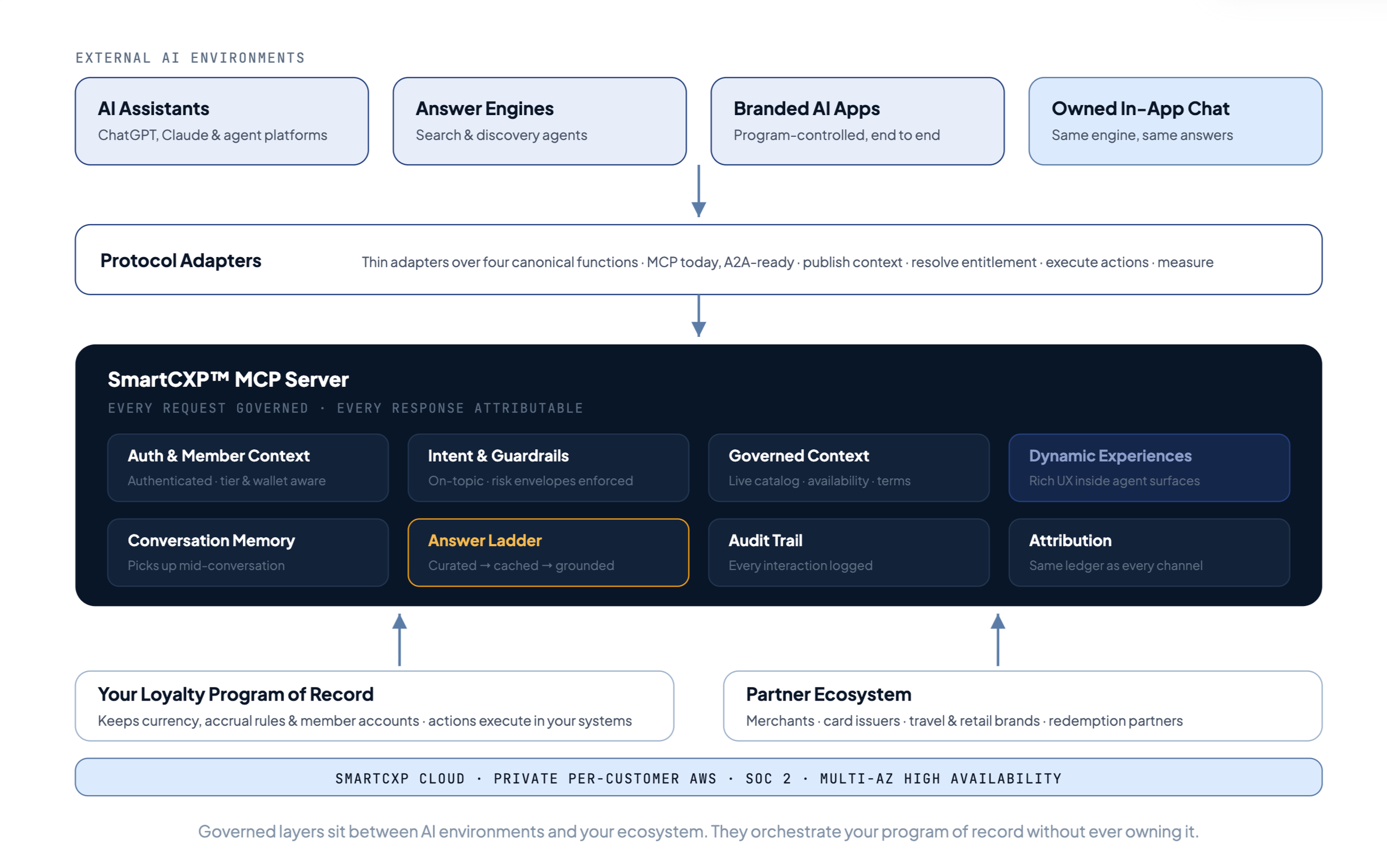
Dynamic experiences
Offers, comparisons, and actions render as branded surfaces inside the agent, so the member sees your product rather than a description of it.
Context awareness
Picks up mid-conversation and holds the thread. Questions outside the ecosystem get recognized as outside the ecosystem.
Consistent everywhere
Your in-app chat and outside agents run on the same engine, so the answer does not change with the doorway a member came through.
What agents actually do with a loyalty MCP server
EXAMPLE OUTPUTS
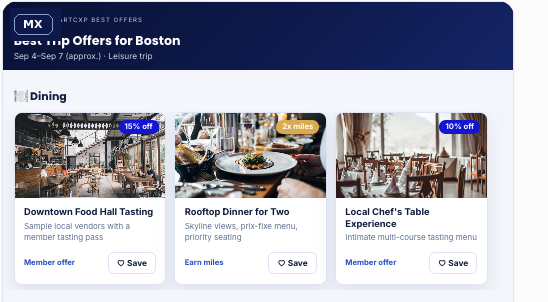
Three answers, rendered live inside an AI assistant.
REAL OUTPUT
A weekend in Boston, answered.
A member asks about a trip. What comes back is a live branded surface holding offers across dining, tours, stays and transport, each one carrying member pricing or earning, each one saveable to the wallet. All of it happens inside the agent and on the program's terms.
Demonstration using a fictitious loyalty program (Meridian) · not a customer deployment
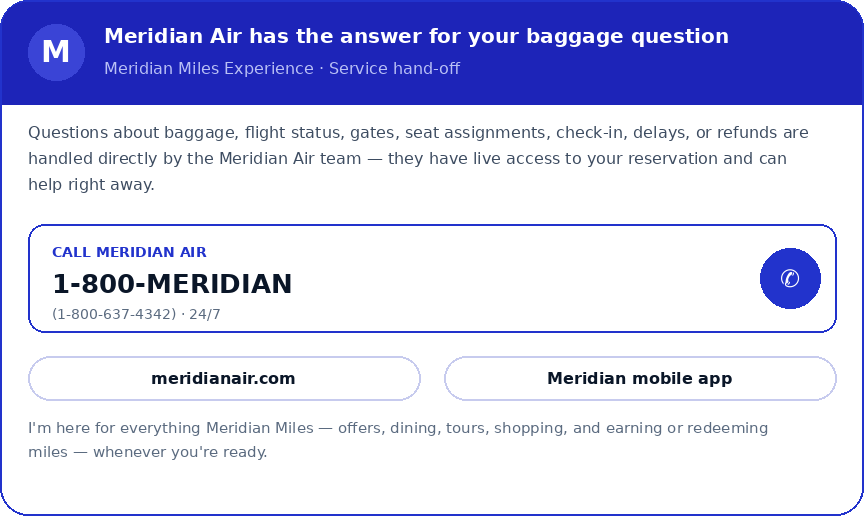
REAL OUTPUT - GUARDRAILS, CAUGHT WORKING
Out of scope, handled properly.
A member says they have lost their luggage. Intent detection reads that as a service question, and rather than improvising baggage policy the answer hands them to the airline’s own line, site, and app, then offers to resume on offers and earning whenever they are ready.
That boundary is the whole point. Service belongs to the program of record and the ecosystem belongs to the MCP server, so the hand-off between them is deliberate rather than a dead end.
Demonstration using a fictitious loyalty program (Meridian) · not a customer deployment
REAL OUTPUT - TWO WORDS IN, FULL EXPERIENCE OUT
“im hungry”
That is the entire prompt. Boston was established earlier in the conversation, so what renders is a full branded surface with a greeting, the city in context, search, filters, and dining cards carrying 3x earning and one-tap activation. The member gets a product, and the agent never had to describe one in prose.
Demonstration using a fictitious loyalty program (Meridian) · not a customer deployment
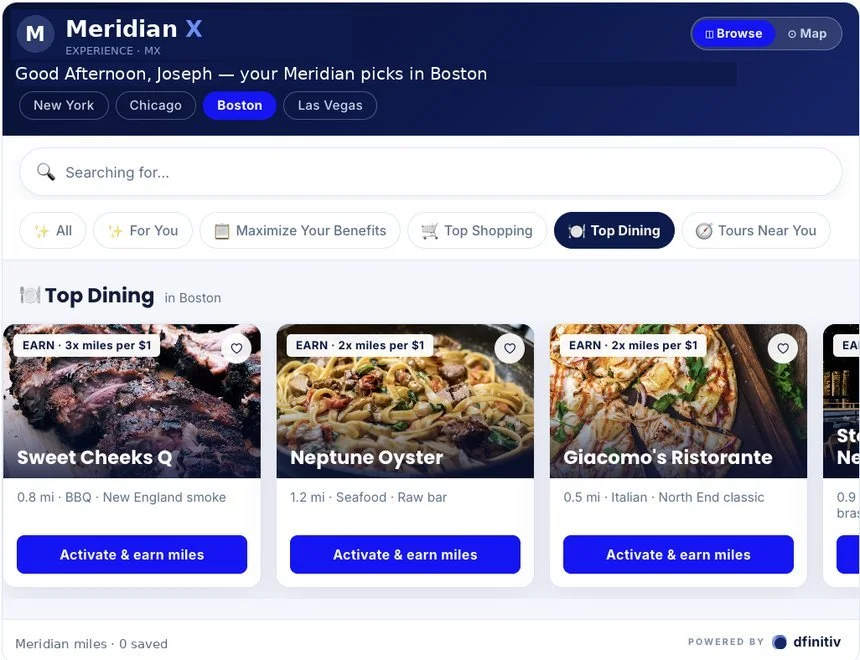
All three were rendered live in Claude on demonstration data. Bring your own questions to a demo and we will run them.
BEHIND THE EXPERIENCES
Every answer comes out of a library.
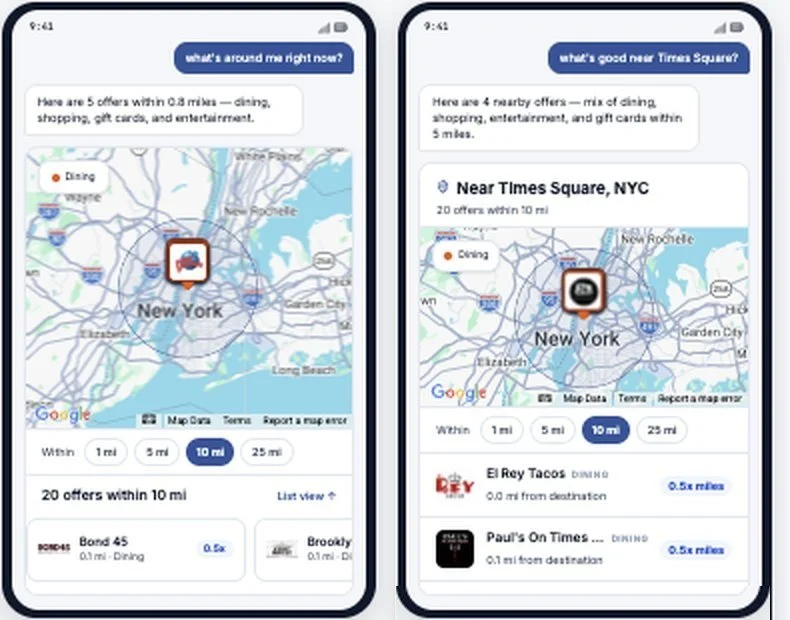
The library is versioned and it keeps growing. Offer cards and carousels, merchant search and comparison, map-based dining discovery, gift-card drill-ins, a live miles estimator, personalized picks, a full home experience, the support hand-off. Every one of them renders against a single set of design tokens, and adding a new one takes minutes.
Governance is written into each spec. Deep links come from a fixed allow-list the model cannot invent, personalization runs through an adapter that never sees PII, and an empty result renders as empty instead of as plausible fiction.
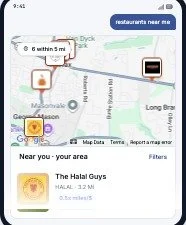
Nearby dining, mapped
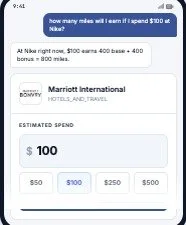
What will I earn?
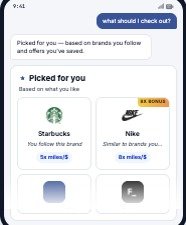
Picked for you
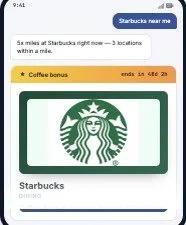
A partner's own page
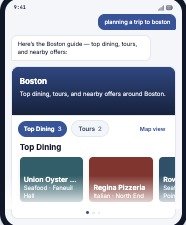
A destination guide
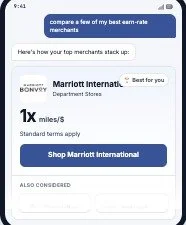
Partners compared
Six of the experiences in the library. Each one is a governed template that any partner can be dropped into.
The answer ladder, and why the bill stays flat
OPERABLE ECONOMICS
Most AI deployments meet their token bill after launch. This one is built so the cheapest accurate answer is the one that gets served.
1 · CURATED
Editorial answers
Program-approved responses for the questions that matter most.
near-zero token cost
2 · CACHE
Learned answers
Frequent Q&A promoted to cache by an auditor step. Faster and cheaper daily.
low cost · low latency
3 · GENERATED + GROUNDED
Editorial answers
Novel questions answered by the model, always grounded in your live catalog.
spent only where it earns
The MCP token tax, and why the program should be the federation point
The 99 apps you did not open on your phone today cost you nothing. Connect a hundred MCP servers to an AI assistant and every one of them spends tokens on every request, whether it gets used or not. That difference should shape how a loyalty ecosystem shows up in the channel.
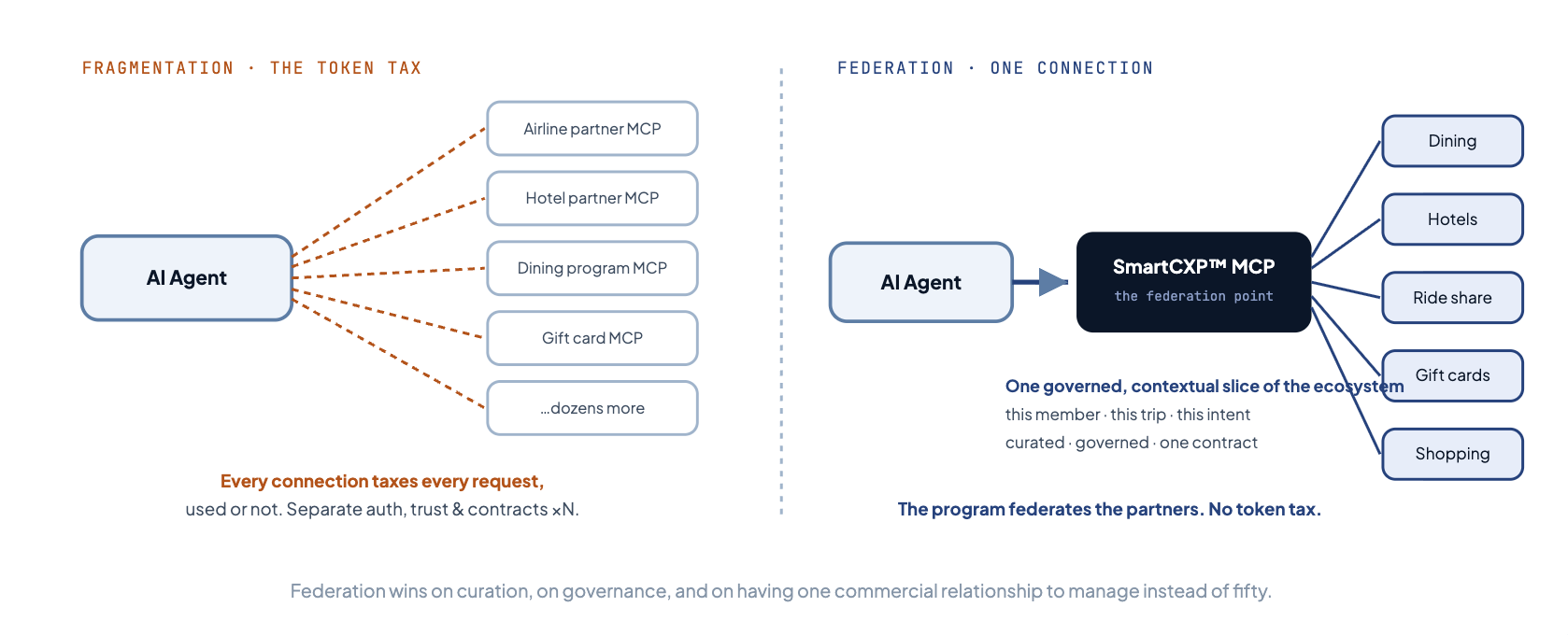
What is actually at stake: whoever becomes the federation point holds the member relationship. If every partner connects on its own, the program ends up as one tool definition among hundreds, which is the OTA story told again in a new channel.
What a security review is going to ask for
ENTERPRISE GRADE
Governance
Answers stay inside the scope you set. Policy-critical questions get fixed responses, and on provided content the behaviour is deterministic.
Economics
Models are pluggable, answers are cached, and cost, cache savings, and token usage all surface on a dashboard.
Auditing
Every conversation is tracked end to end. You can pull up any question, its result, the path it took, and the data behind it.
User Experience
Branded experiences get added and updated in real time as questions, partners, and content change.
+ CONVERSATION MANAGEMENT · CONTEXT THAT FOLLOWS THE MEMBER
Mid-session context derives where the member is in a trip or purchase. In-conversation reinforcement keeps external agents from losing the thread. Partner-gap signals surface unmet demand from real questions.
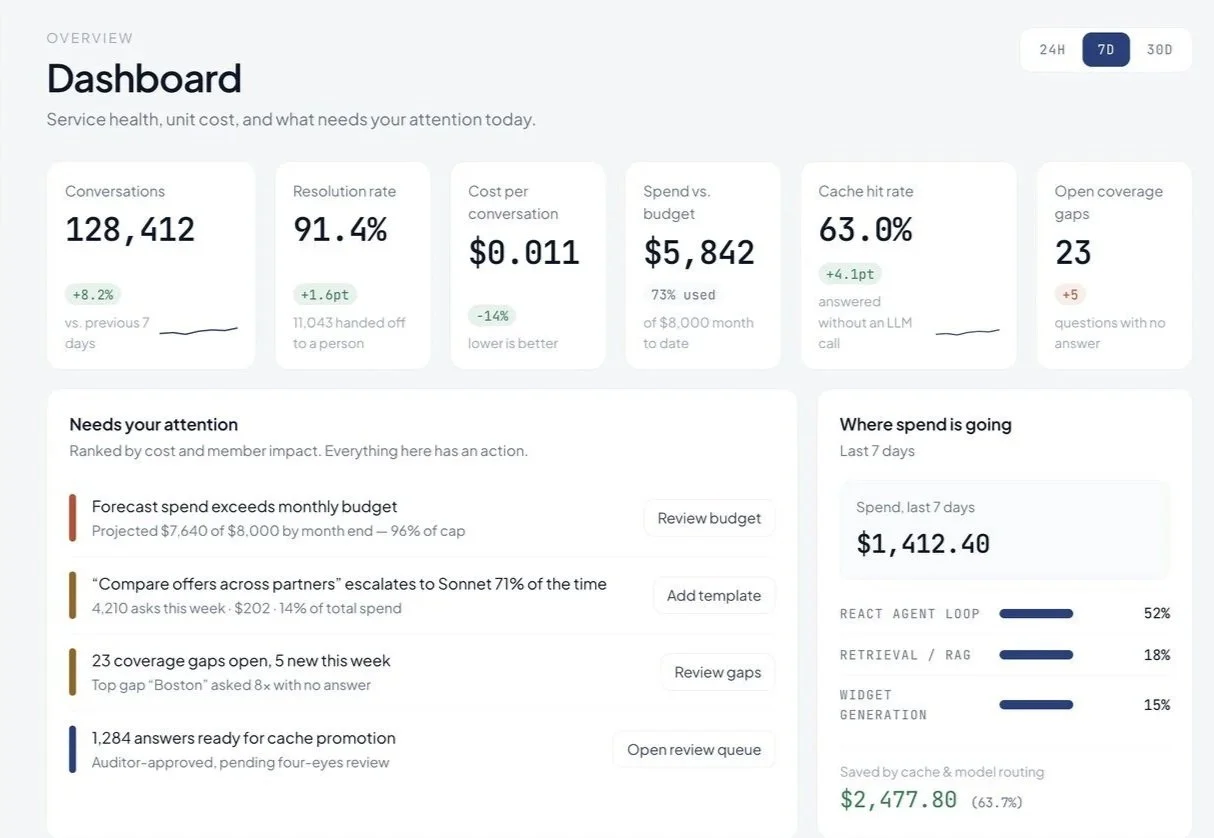
The four pillars as a console: SmartCXP™ AI Center · budgets & unit economics, cache efficiency, four-eyes answer review, coverage gaps · sample dataThe basic server is easy. Everything around it is the product.
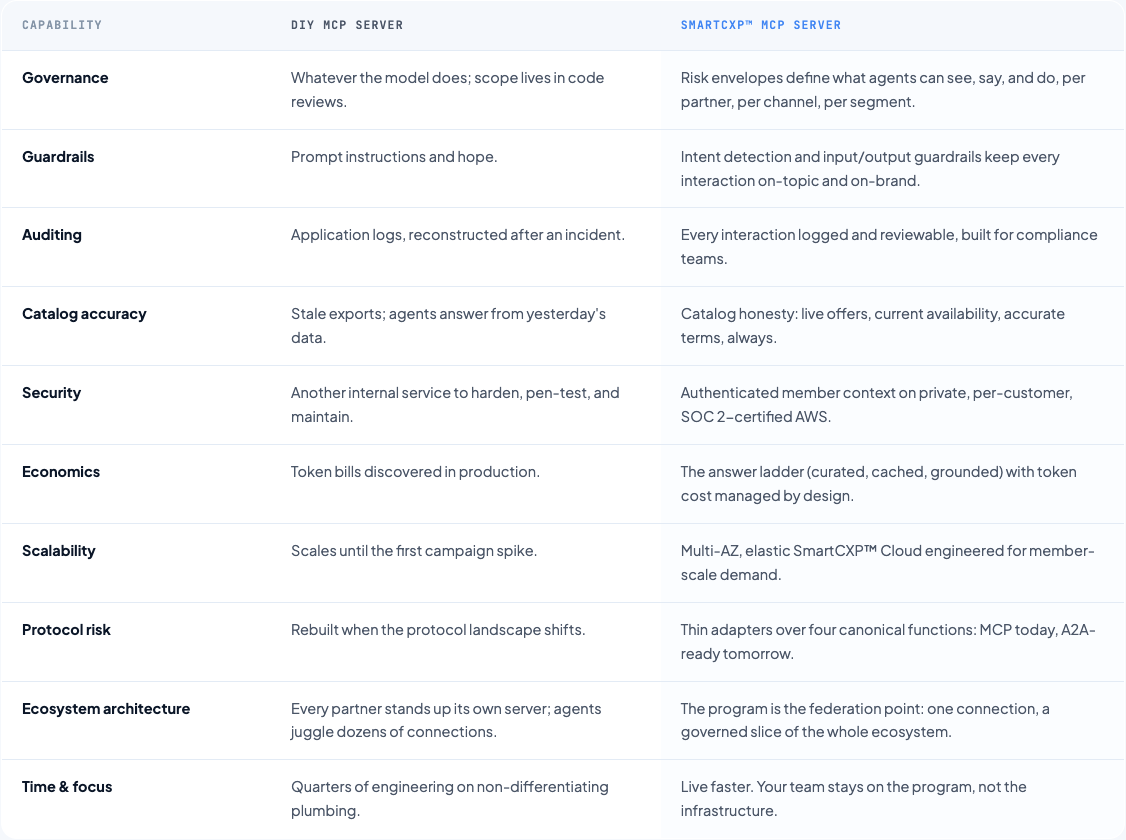
Any competent team can stand up a demo MCP server in a sprint. What takes quarters is everything that has to survive a security review, a finance review, and a brand review afterwards.
On build versus buy: your real alternative is DIY, and the basic server is not the part that will hurt. Auditing, governance, guardrails, security, scale, and unit economics from day one are. A demo clears none of them.
Launch is where the work starts
SmartCXP™ runs the partner lifecycle after go-live, which is the point where most channels quietly stop improving
01
Enable Stand up tools, intents, and experiences for your partner catalog.
02
Learn Read what members actually ask, what converts, and what confuses them.
03
Close coverage gaps Catch the questions the channel handles badly and fix them with a curated or cached response.
04
Find partner gaps Find demand with no partner attached to it, size the opportunity, and go recruit.
05
Evolve the UX Improve the experiences agents render as member behavior shifts.
06
Manage the economics Tune the answer ladder, the caching, and the token spend across every channel.
FREQUENTLY ASKED QUESTIONS
MCP servers for loyalty, answered
-
An MCP (Model Context Protocol) server gives AI agents a governed way into a brand's data, content, and actions. The agent works from permissioned facts rather than scraped guesswork, and it gets the tools to act on them.
-
It makes a loyalty program's partner ecosystem native to AI environments. Interactions across merchants, brands, and redemption partners stay member-aware and tier-aware, and every one of them is attributable.
-
You can build a basic server quickly. The part that takes quarters, and carries the risk, is auditing, governance, guardrails, security, scale, and token-cost management. SmartCXP™ arrives with those already in place.
-
No. Your program of record keeps the currency, the accrual rules, and the member accounts. SmartCXP™ orchestrates partner discovery, offers, and actions that then execute through your systems. It extends the ecosystem without owning any of it.
-
Very little on your side. Protocols are treated as thin adapters over four canonical functions, which are publishing context, resolving entitlement, executing actions, and measuring outcomes. MCP works that way today and A2A will slot in the same way.
-
A loaded MCP connection spends tokens on every request whether it gets used or not, which is the "MCP token tax." A single program-level server federates partner context instead, so you carry one governed slice, one auth relationship, and one contract. The program that federates also keeps the member relationship.
-
On SmartCXP™ Cloud, which is private, per-customer AWS infrastructure with no co-mingled tenancy, encryption in transit and at rest, and multi-AZ high availability. Dfinitiv is SOC 2 certified.
See a governed MCP server answer for your program.
Bring one partner and one member question. You will see the curated answer, the cached answer, and the generated one, along with the audit trail behind all three.